by Pierre
Gagnaux ©
|
(click on photos to enlarge)
FAKEBERGE'
FAkeBERGE (fake Fabergé) is the English version of the
joke definition FAuxBERGE used (in French) by A. de
Solodkoff for items, maybe old, maybe Russian, but made
by another silversmith and enriched in their value and
monetary worth by fake Fabergé hallmarks.
Now, a lot of rough copies of 'Fabergé pieces'
are available on the market, and unscrupulous dealers
refer to ... 'export items' or some other oddity to
justify their provenance and workmanship quality.
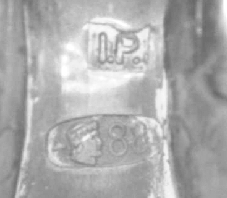
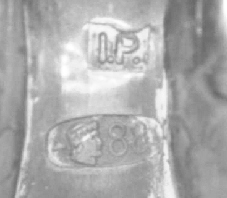
On the photograph below right the trap is more subtle as
this is a piece of old manufacture, but, unfortunately,
I'm not authorized to show it in its entirety.
|
The hallmarks appear to be those of Julius
Alexandrovitch Rappoport (1864-1916), working for the
Fabergé firm in his own establishment, using the punch
of Moscow (period 1908-1917) and the standard Fabergé
silver fineness of '88 zolotniki' (916 thousandth
silver).
Unlike St. Petersburg, Fabergé didn't use the
master silversmith's mark in Moscow workshop. This type of marking
does not demonstrate that the object was truly sold
by the Fabergé firm, but, above all, does not belie the
fact that Rappoport never worked in Moscow.
You may draw your own conclusion...
The object is of adequate quality, rather dirty and, at
first glance, it looks consistent with what it claims to
be, but ... with more thorough analysis ... the
suspicion arises . |
 |
|
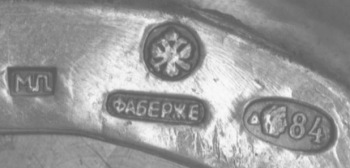
We go now to another object and
to the questions arising from the examination of its
markings. |
 |
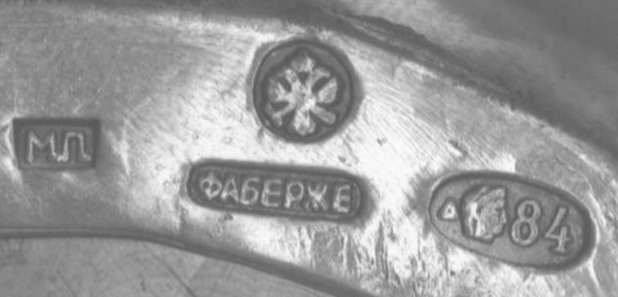
On
the left there's the hallmark of another master
silversmith: Mikhaïl Perchin (1860-1903), the Fabergé
mark, the Imperial Privilege of St-Petersburg, and the
town control mark of Moscow with the silver fineness
mark of 84 zolotniki (875/1000).
Unfortunately the town control mark of Moscow is for the
1908-1917 period, which is at least five years after the
death of Mikhaïl Perchin. |
The field of hallmarks is extremely broad and there's no
shame in consulting reference books. It is better to compare
two or three to avoid an error.
And, undoubtedly, the study of Russian silver is
particularly difficult, owing to the many years which
elapsed before well documented books on Imperial Russian
silver hallmarks were available.
An obvious and final suggestion, if you buy Russian
silver with a renowned signature: sometimes the
conclusion obtained after a thorough and accurate
analysis of the piece is quite different from the first
impression resulting from the simple consultation of a
specialized library, the written warranty of the dealer,
and/or the excellence of its workmanship. |
But, I believe that my readers will also be interested
in the images of some authentic Russian hallmarks.
As I said previously, the mark 'Fabergé' was not
systematically punched on the silver and usually only
the Master's marks can be found.
Solodkoff in the book 'Fabergé Joaillier at the court of
Russie' page 153, confirms that most St-Pétersbourg
productions do not have the 'Fabergé' signature and is
struck only with the initials of the master head of the
workshop. |
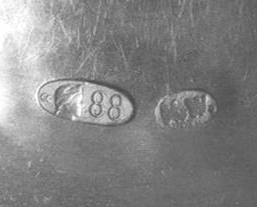
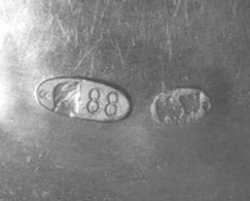
| On
the right you see a photo taken from page 120 of the
book 'Fabergé' (by A. of Solodkoff, Editions Atlas),
with the 'signature' of Henrik Wigström and the silver
title of 88 zolotniki for the town of St-Pétersbourg,
but without the signature of Fabergé. The details of this
mark are much better than those in the previous photo.
|
 |
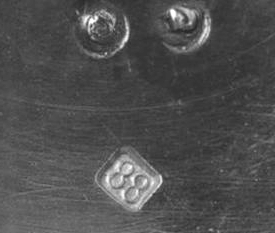
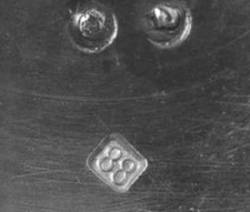
There's also another very rare and interesting mark
unseen on pieces of other silversmiths. I have never
seen this mark anywhere else.
It is the title of 88 zolotniki in a square outline (I
saw something similar only on a 84 zolotniki mark of the
end of 18th century/beginning of 19th century). |
Beside this unusual mark (on the inside of a lid) there
are the tops of two rivets fixing the monogram to the
lid. The use of rivets is a characteristic of Russian
silversmithing, as the objects were not especially made
but adapted, each time, to customer's requests.
|
 |
Pierre Gagnaux
photos by Pierre Gagnaux
|
|
|
 ASSOCIATION OF SMALL COLLECTORS OF ANTIQUE SILVER
 Francais